Photography Impostor Syndrome: Why Feeling Like a Fraud Means You're Improving
I have been taking photographs for more than ten years, and I still hear a small voice every time I lift the camera. It asks me what I think I am doing. It points out that I haven't been to photography school. It reminds me that I make my living from a 9-to-5, not from prints or commissions. After a while you start to wonder whether the voice is right.
If you have ever felt the same thing, this post is about photography impostor syndrome: when it shows up, why photography seems to trigger it more than other things in your life, and the reframe that finally helped me keep going.
Nothing in this piece is going to make the voice disappear. What I can offer is a different way of reading the signal, because I spent a long time reading it the wrong way around.
When Photography Impostor Syndrome Shows Up
There are three specific moments where the feeling hits hardest for me. They are probably the same for you.
The Moment Before You Raise the Camera
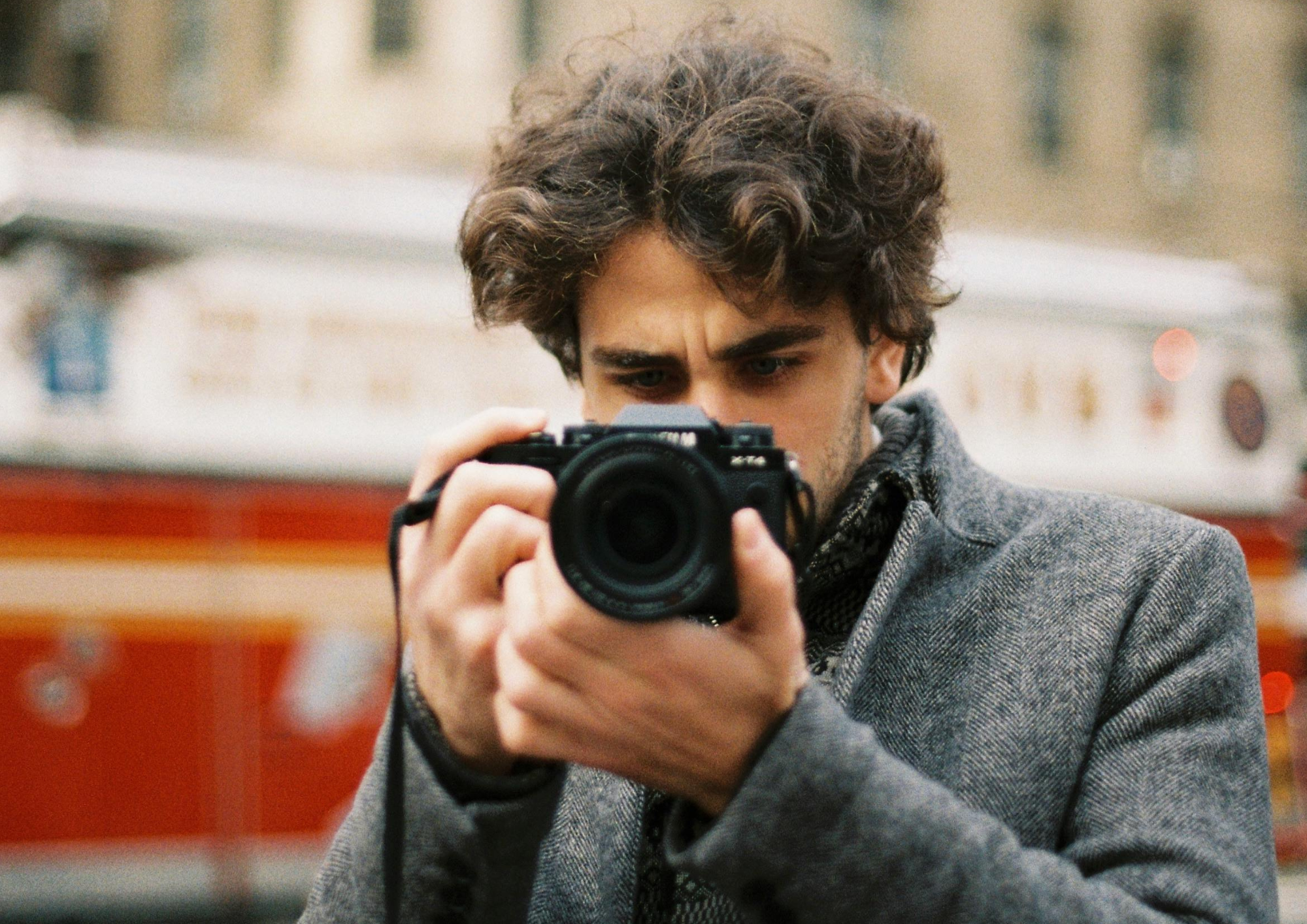
The first one is the few seconds before the shutter. You see a frame. You feel the impulse to lift the camera. Then a quiet calculation runs in the back of your head about who is around, who might look, what they might think, and what kind of person you appear to be standing on the street with a camera in your hand. Sometimes the calculation runs faster than the impulse and the camera stays where it is.
If you are reading this and recognizing yourself, you are not alone. I wrote about more of these specific moments in Read: The Introvert's Guide to Street Photography, where I tried to map the social geometry of photographing in public. The calculation is structural, not personal.
The Moment You Look at the Photo
The second moment comes right after. You take the photo, you press play on the back of the camera, and you find a flaw. Sometimes it is technical. The white balance is slightly off. There is grain where you didn't want grain. The shutter speed was a hair too slow and there is a soft edge where the subject moved. Sometimes the flaw is harder to articulate. Something just feels not quite right.
You are pretty sure a real photographer wouldn't have made that mistake. So you flag it as evidence and add it to the file.
The Moment You Try to Show It
The third moment shows up when you try to publish or share. You hover over the upload button. You scroll through your camera roll. You wonder if the photo is good enough to be seen, then you wonder whether you are good enough to be the person making it.
Most photographers I know have, at some point, confessed to feeling like a fraud. A piece in Fstoppers in early 2026 put it bluntly: almost every photographer they spoke to had, at some point, confessed to feeling like a fraud. That sentence stayed with me, because it does not match what we see online. We see other photographers' polished feeds and assume confidence. Beneath the feed, the same calculation is running.
Why Photography Triggers Impostor Syndrome More Than Other Things
I do other things in public. I work a 9-to-5. I take meetings, I present, I talk to strangers in cafes. I don't feel a fraction of this self-consciousness in any of those situations. Photography is structurally different from most of what I do during the day, and that difference matters.
There are three reasons photography seems to trigger this kind of impostor feeling more than other things, and once I saw them, the feeling started to make more sense.
Photography Output Is Publicly Visible and Instantly Comparable
A writer's drafts are private. A musician's practice is mostly behind closed doors. A photograph, once it leaves your camera, lives on a feed next to the top 0.1 percent of photographers in the world. The algorithm is always showing you their best frames, never their misses. You compare your everyday output against their highlight reel and conclude something is wrong with you.
Nothing is wrong with you. The reference class is broken.
"Photographer" Is an Identity Claim, Not a Credential
Nobody hands you a card that says you are a photographer. There is no licensing body, no required exam, no professional registration. The word is something you start to use, and every time you use it part of you is still asking permission.
Compare this to most other identity claims. "Doctor" requires a degree. "Engineer," in many countries, requires accreditation. Even "accountant" comes with letters. "Photographer" is a word you decide to apply to yourself. Whenever you use it, you are essentially testing whether anyone challenges the claim.
That uncertainty creates space for the small voice. The voice fills the silence with doubt because no external structure is filling it with confirmation.
Photography Is Mostly a Solitary Practice
A lot of the work happens alone. You walk alone, you frame alone, you cull and edit alone. Real feedback is delayed and sparse. Comments arrive long after the photo was taken, if they arrive at all. Likes are noise, not signal. So you are mostly left with your own internal critic, who is more vocal and more confident than the actual evidence warrants.
This is where photography differs from team work or even from most creative practices that involve a collaborator or a daily editor. The inner critic gets amplified because nothing else fills the room.
The Reframe That Changed Everything
For a long time I read the feeling like this: the discomfort proves I am not really a photographer.
Then I learned about the Dunning-Kruger effect, and the entire signal flipped on me. I had been reading it backwards.
The short version of Dunning-Kruger is this: people who are genuinely incompetent often don't know they are incompetent. They lack the self-awareness to spot the gap between what they are doing and what good work looks like. Conversely, people who are getting better often feel like frauds, because they can finally see the gap between what they want to make and what they can. The discomfort is not evidence that you are failing. It is evidence that your eye has matured to the point where you can see your own ceiling.
If you fixate on minor technical flaws that no client would ever notice, that is not a deficit. That is craftsmanship arriving early, before your hands have caught up. High standards looking like flaws is exactly what improvement feels like from the inside.
The photographers who never feel this are usually the ones I worry about. Not because they are bad people, but because their discomfort signal is muted, and that signal is what tells you where to invest your attention next.
I cannot tell you the feeling will go away. It probably won't. What changed for me is that I stopped reading the feeling as a verdict and started reading it as calibration.
What Actually Helps
Reframing the feeling is necessary but not sufficient. The voice doesn't quiet down because you understand it. The voice quiets down because you build practices that prove the voice wrong, slowly, over a long stretch of time.
These are the three things that actually moved the needle for me.
Cap Your Input
If you spend two hours a day scrolling other photographers' work, your reference class for "what photography looks like" is now everyone else's best frame. That sets the bar at a place no one's daily output can reach. The fix is mechanical: cap how much you consume, especially the channels that consistently make you feel small. To some extent, comparison is useful. Past a certain point, it is just self-harm at scale.
I am not telling you to delete Instagram. I am telling you to notice the dose-response relationship between how much you consume and how worthy you feel of carrying a camera that day.
Put the Work Out Anyway
Action erodes doubt faster than thought ever has. When I sit and think about whether I should publish a photo, the voice always wins. When I publish first and read the feedback later, the voice has nothing to do but watch.
You don't need a big audience. You need a tiny stream of work going out. A folder you share. A small newsletter. A handful of friends. The shape doesn't matter. The act of releasing the work into the world breaks the loop where every photo lives only in your head and gets graded against the perfect version of itself.
If publishing feels especially loaded, Read: Street Photography Anxiety? Avoid These 9 Mistakes covers some of the specific moments that make pressing the share button feel disproportionate to its actual stakes.
Define Your Version of "Photographer"
This was the hardest one for me, and the one that changed the most.
I do not want to be a full-time professional photographer. I like my 9-to-5. I like the contrast between logical work and creative work, and I think my creative work is better because the logical work has a separate room to live in. I am never going to be the person who makes a living from prints. So when I say "photographer," I cannot mean what a professional means.
For a long time I treated this as a problem. The fix was not finding a way to become a professional. The fix was writing down what I actually wanted "photographer" to mean for me. A practice I show up for. A way of seeing. A small body of work that grows over years. A handful of photos a year that I am proud of.
Once I had that definition, the gap between what I do and what "real photographers" do stopped mattering. I was no longer competing in the wrong league. I was just doing my version, and the question became whether I was getting better at my version, not whether I qualified for someone else's.
If you want to ground your own version in a practical way, Read: Best Cameras for Shy Street Photographers has a frame for thinking about which camera supports the practice you actually want, separate from the practice you imagine "real photographers" have.
A Quiet Closing
I cannot promise the voice will go away. Mine still shows up. It showed up earlier this week, when I was framing a photo in a small park near my apartment, and the calculation ran in the back of my head about whether the woman two benches down was looking at me. I lifted the camera anyway, took the photo, and walked on. The voice was still there. The walk continued. That is, more or less, what working through photography impostor syndrome looks like in practice.
If you took a photo this week, you are a photographer. If you took one last month and none since, you are still a photographer who is between photos. The word is not a badge that gets revoked when you go quiet. The work counts. The intention counts. The way you see the world when you walk through it counts.
You are not reading a fraud signal. You are reading a calibration signal. Keep walking. Keep lifting the camera.
I'm Cesar, I take photos around a day job.
