World Cup TV Photography: Why the Grainy Shots Spread
The photos everyone shared were shot off a couch
Some of the most-shared images from the 2026 World Cup were not taken in a stadium. They were taken in living rooms. People pointed their cameras at their own televisions, photographed the match off the screen, and those grainy, smeared frames traveled further than the pristine ones shot from the sideline. That is the whole strange story of World Cup TV photography this summer, and I have not been able to stop thinking about it.
I did not shoot any of this. I have no dramatic tale about sneaking a lens into a stadium or getting turned away at a press gate. I watched it happen like you probably did, one repost at a time, and somewhere in there it stopped being a novelty and started feeling like a question aimed straight at how I think about pictures. So this is me reacting, not reporting from the field. I want to walk through what actually happened, what people are arguing about, and the one idea underneath all of it that I think matters more than the trend itself.
Let me set the scene first, because the specifics are better than any summary.
Florence Pernet and the memory of watching
Florence Pernet is not a hobbyist who stumbled into a look. She is a working professional. She has photographed PSG, she covered the 2024 Paris Olympics, she has shot campaigns for Nike, Adidas, and Lacoste. That background matters, because it kills the easy assumption that shooting off a TV is what you do when you cannot do the real thing. She can very obviously do the real thing.
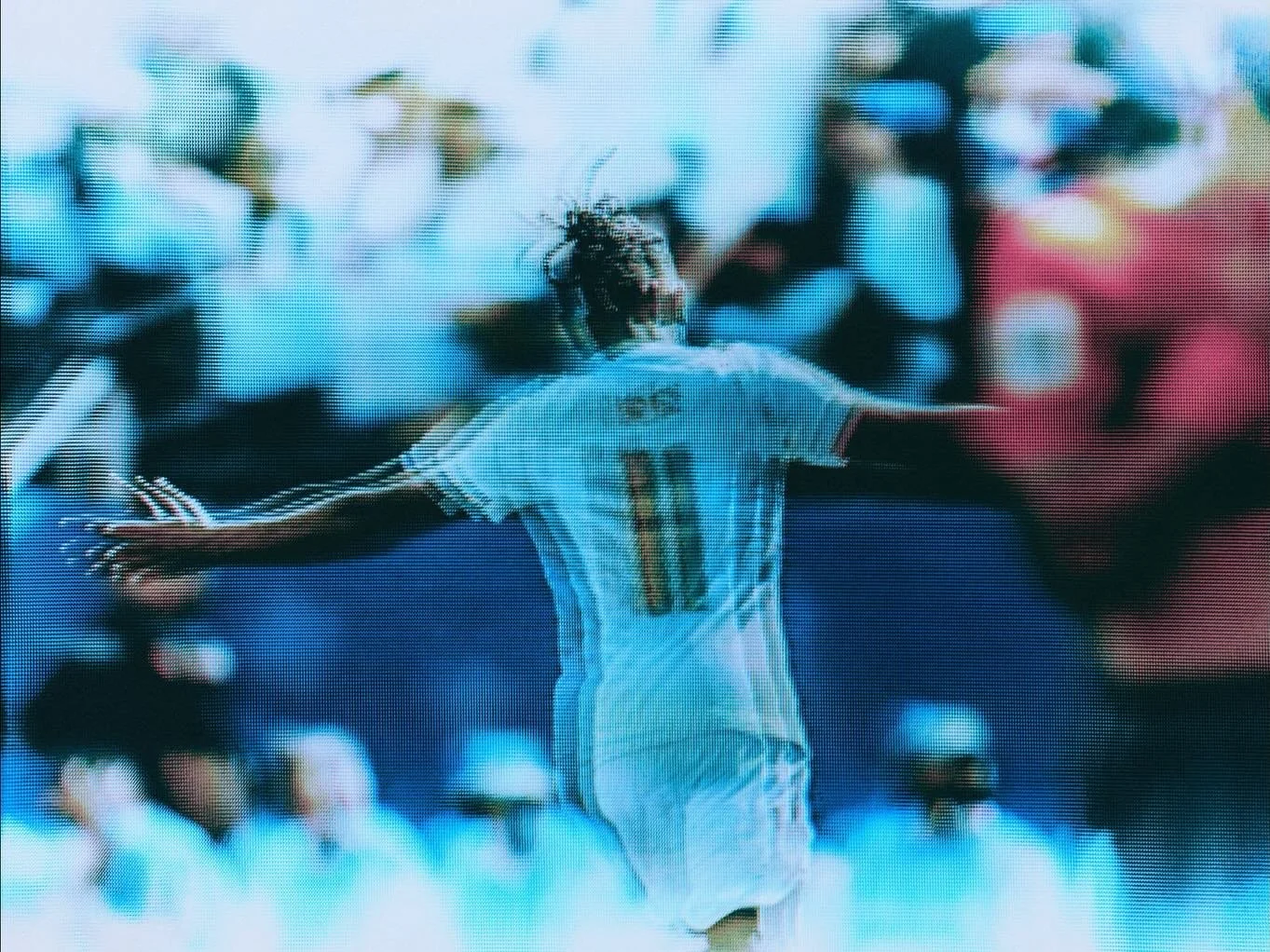
During the World Cup she photographed matches off her home television, and she did it as a deliberate style. She zoomed in until you can see the screen's pixels. She dragged the shutter so the players smear into motion. She graded the color heavily. The result does not read like match coverage. It reads like a memory of watching a match, the way the feeling of a goal stays with you long after the exact geometry of it blurs. It feels second-hand, and somehow more personal for it.
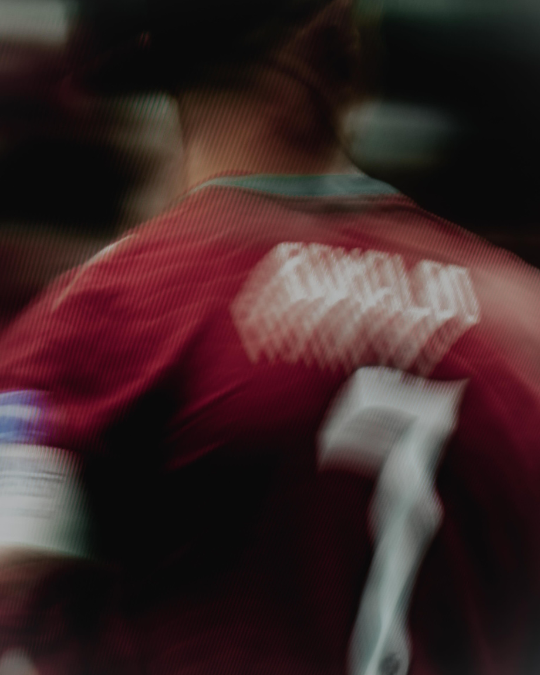
People responded to that in a way you rarely see. The France winger Michael Olise deleted his entire Instagram and now posts only her TV-screen shots of himself. Think about what that means for a second. A professional footballer had access to every wire photographer's sharpest work, and he cleared it all out for a set of images made by pointing a camera at a television. The Portuguese national team reposted one of her grainy TV frames of Cristiano Ronaldo, and they ran it right next to the crisp professional wire images. Same player, same moment, and the deliberately degraded version earned its place on the official feed.
Why she shot from the screen is genuinely unclear
I want to be careful here, because the story got flattened as it spread. The viral version says FIFA denied Pernet accreditation and the TV work was her workaround. Her own interview tells it differently: she says she chose not to apply, and planned to watch the tournament as a fan. Those two accounts do not line up, and I have not seen anything that resolves them. So I am not going to tell you why she did it. Maybe it was constraint, maybe it was a pure creative choice, maybe some of both. The honest answer is that it is contested, and the picture I get to reckon with is the same either way.
The photographer who got shut out
The other case is cleaner, and it is the one that made me sit up.
Sidy Talla is Senegal's official team photographer. He was denied a visa, which meant he could not travel to Canada for Senegal's match against Iraq. Senegal won that match 5-0, and Talla was not there for any of it in person. So he photographed the match off his hotel-room television instead. The journalist Romain Molina reported this in late June 2026.
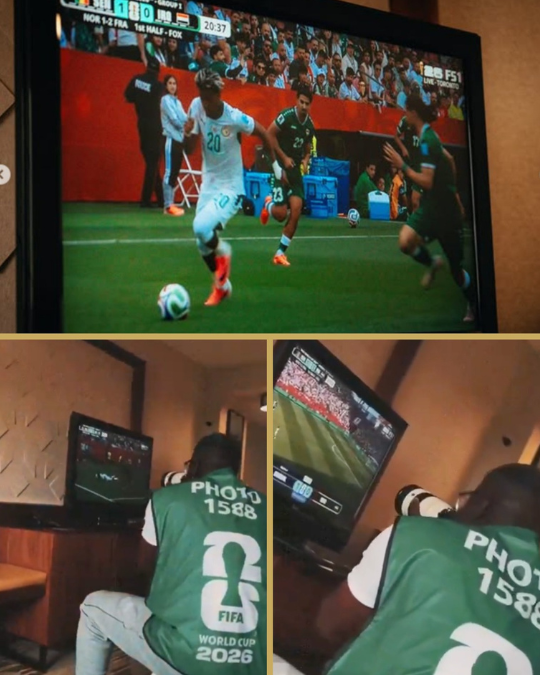
What stayed with me was how Talla talked about it. He said that even outside the stadium his passion was intact, and that whatever the circumstances, whenever the photos were taken, the point was to tell a story through each image. There is no bitterness in that. He had every reason to frame it as a loss, a photographer robbed of his event, and instead he treated the constraint as just another set of conditions to make something inside. The job was to tell the story. The TV was what he had, so the TV is what he used.
I am keeping Pernet and Talla separate on purpose, because their situations are not the same. Talla was plainly shut out by a visa problem. Pernet's reason is the contested part. Lumping them together as one neat "denied access, got creative" narrative loses what is actually interesting about each of them.
Access at this level is rationed on purpose
It helps to know how tight the door is. FIFA rations photographer accreditation with a per-country quota, and its own media guidance reserves the right to reject anyone. So access is not a wide-open thing that a good portfolio guarantees. It is a limited number of seats, allocated by rules that sit outside any individual photographer's control. I am not going to throw out a figure for how many people got turned away, because I have not seen a number I trust. The point is only that the gate is real, it is narrow, and being excellent at your craft does not by itself get you through it.
That context is part of why photographing matches off a TV screen went from a workaround to a recognized way of covering the tournament. When the front door is quota-controlled, the picture of the match becomes something you can only get second-hand, and the roughness of a second-hand image turns into exactly what people want from it.
What "photographing a broadcast" actually is
Let me be precise about the technique, because it is easy to misread.
This is not screen-grabbing. Nobody is saving a still off a stream and running it through a filter. It is re-photographing the broadcast: pointing a real camera at a television that is playing the match, and taking a picture of the screen. The grain and the moire and the faint scan lines all come from the physical act of pointing a lens at a screen. Those artifacts are the aesthetic. They are what makes the image read as watching from a couch, on a delay, the way most of us actually experience the World Cup.
If you have ever tried to snap a photo of your own TV with a phone and gotten those weird rippling bands across it, you already know the effect. The trick is that these photographers are not fighting the bands. They are using them.
This has a quiet precedent
It also is not brand new. Back in 2020, during COVID, Getty Images deliberately used Zoom video calls as a photographic medium. They shot athlete portraits through a screen, on purpose, because that was how the world was seeing each other that year and the medium carried the meaning. World Cup TV photography is a cousin of that idea. When the real event is stuck behind glass, some photographers just made the glass part of the photo.
The rights question, hedged honestly
I have to slow down here, because I am not a lawyer and this is not legal advice. What I can do is tell you what IP sources tend to say, and flag it as a live debate rather than settled law.
A broadcast is its own copyrighted work. From what I understand, that copyright generally reaches even a single still frame lifted from it, and re-photographing the screen does not obviously escape that, because the underlying thing you are capturing is the protected broadcast. There is no clean exemption just because a shot is a fraction of a second, or because you credited the broadcaster, or because you clearly transformed the look. Those things feel like they should matter, and legally they may not in the way people assume.
At the same time, as far as anyone publicly knows, nobody has been sued over any of this. So it sits in a genuine grey area. I am not telling you it is fine and I am not telling you it is forbidden. I am telling you it is unresolved, and if you were ever going to do it with anything at stake, it is worth knowing the ground is soft. That is as far as I will go on it.
The question that actually matters
Here is the part that reorganized something for me.
Every argument about these images wants to be about resolution. Is it sharp enough. Is it high-res enough. Does a professional wire photo with a long lens and perfect focus not simply beat a smeared frame of a television. On those terms the stadium photos win every time. They are technically flawless. And people looked at the flawless ones and the broken ones side by side, and a lot of them chose the broken ones anyway.
That should be impossible if sharpness is the thing that makes a photo good. It is not impossible, which tells you sharpness was never the real question. The question a photographer is actually answering was never "is this clean enough." It is "what is this image for? What job is it doing for the person looking at it?" The stadium photo does the job of documentation. It says here is exactly what happened, in full clarity, for the record. The TV photo does a different job. It says here is what it felt like to watch this from my couch, on a delay, aching for a team I could not be in the room with. Those are different assignments, and for a huge number of people the second assignment was the one that mattered.
The reason the TV shots traveled is that they carry a point of view. They feel authored. You can tell a specific person made a specific set of choices about how this should feel, and that authorship is legible even through the grain. Maybe especially through the grain. A perfect wire image is built to disappear the photographer. The rough one leaves their fingerprints all over it. This is the same thing I keep circling back to when I think about what separates a picture that is technically correct from one that is unmistakably yours. Read: How Black and White Photography Can Reveal Your Signature Style
There is a gear lesson buried in this too, and it is almost funny. The most talked-about images of a global tournament were made with a television and a camera pointed at it. Not a body worth more than a car, not a lens the length of your arm. That does not mean equipment is worthless. It means the equipment was never the thing carrying these photos. Something else was. I have written before about how often the more capable tool is not the one that makes the photo work. Read: iPhone vs Fujifilm X100VI: When Your Phone Is Actually Enough
Where this leaves me
I do not think you should run out and photograph your TV. That is not the takeaway, and if it becomes a trend for its own sake it will get boring fast, the way every look does once it detaches from a reason. What I took from watching World Cup TV photography spread this summer is smaller and more durable than a technique.
The next time I catch myself asking whether an image is sharp enough or clean enough or shot on the right thing, I want to swap the question. Not is this good by some checklist. What is this picture for, and does it do that job for the person on the other side of it. Sidy Talla, shooting a 5-0 win off a hotel television because a visa kept him from the stadium, had already answered it. The point was to tell the story. The rest was just the conditions he had that day.
I'm Cesar, I take photos around a day job.
